Suburbs over speed

The car's emergent benefits were worth far more than the time it saved. The same will be true of clinical AI.
In 1929 the first families moved into a town the City Housing Corporation had laid out on farmland in Fair Lawn, New Jersey1, planned for people who would own cars2. Houses faced shared greens, with garages on the street side. It was farmland the housing market had passed over.3
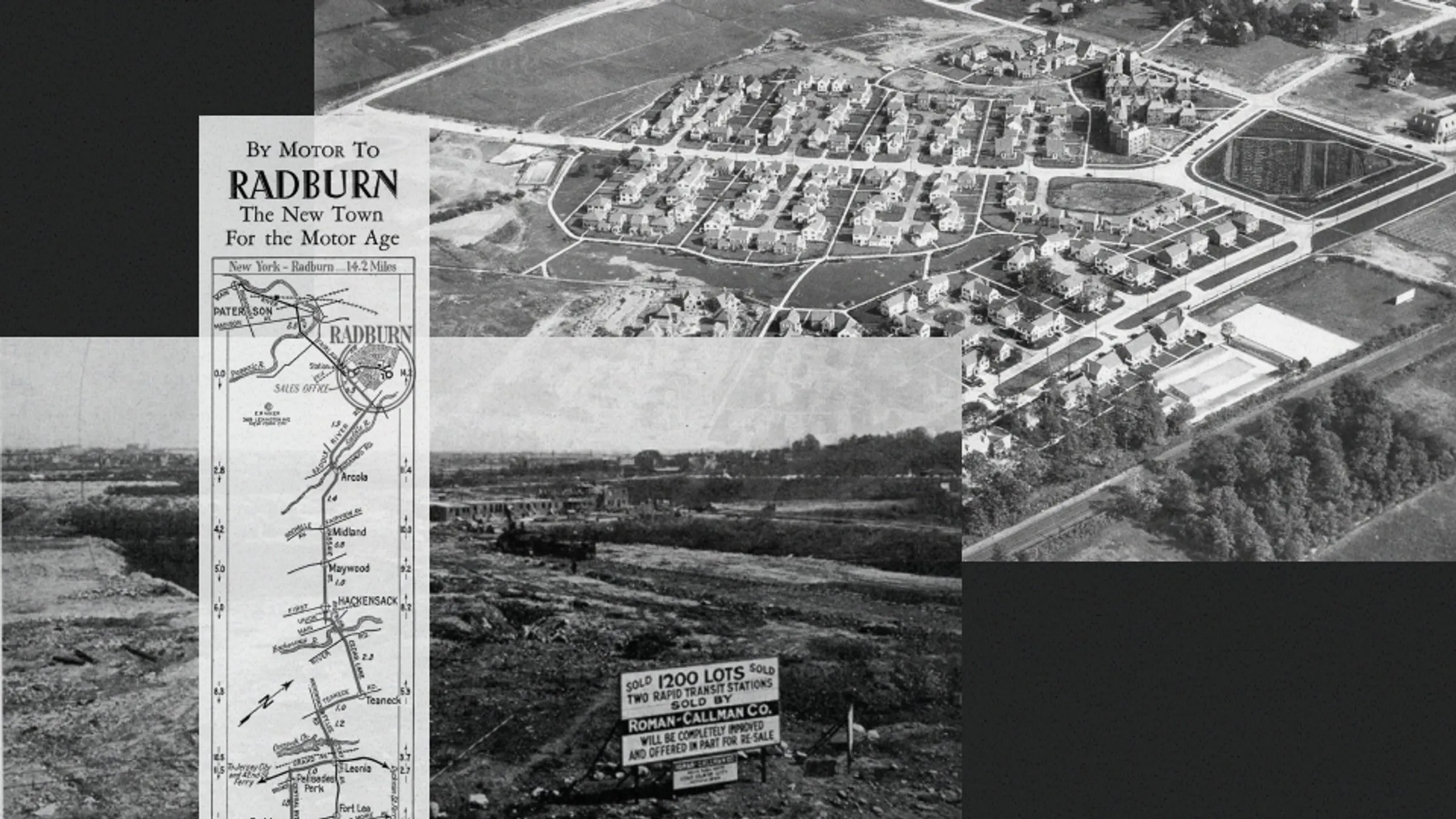
That land had stayed farmland for a reason. The transport options defined the edge of the city: you lived within walking distance of work, or along a line the horses pulled, and everything past that stayed in crops. When the car arrived, empty pastures became suburban dreamscapes: city workers swapped their cramped apartments for houses with a yard and a spare bedroom that they previously thought unattainable. As cars changed where people could live, trucks did it for goods: a shop no longer had to sit beside a rail depot to keep its shelves stocked, deliveries came to the door, from anywhere the roads ran.4
None of that was the sales pitch for the car, nor was that impact explicitly understood in the early days. Ford was selling a quicker way to get around. But these emergent benefits were worth far more than the time saved.
Our industry has a similar dynamic. The questions we often ask revolve around what AI makes more efficient: minutes off a review, more cases per nurse, more auto-approvals, lower cost per gap closed. More specifically, we ask what will make our own departments or workflows faster — utilization management, appeals, care management, HEDIS, payment integrity. Those are reasonable but small questions. But do we want the best minds in our organizations to be stuck making workflows faster when they could use essentially infinite clinical intelligence to redefine how a health plan can care for its members?
You have to think about AI starting in the design, not something you bolt on as you go.
Silos made sense
Health plans were not always this complex. A mid-century insurer mostly priced risk and paid bills; the clinical questions were few enough that a small medical staff could handle whatever came up. Then our jobs grew; federal utilization review went national in the 1970s5, and managed care expanded rapidly through the 1980s and 1990s6. Each wave of regulation and benefit design has added decisions a plan is required to make: whether care is necessary, whether it is coded correctly, whether quality measures are met, whether documentation supports the risk score. Every new obligation has meant we have more records to read, and more judgments to form.
We responded to that growth by dividing up the labor. No one person can hold criteria for every service line, the care resources of every county, and the documentation rules of every program in their head at once. Human attention has limitations, so we split the work into utilization management, care management, appeals, quality, and payment integrity, and trained people to go deep on one question rather than attempt to answer all of them, all at once. The specialization has been valuable; a nurse who reviews the same class of request all day is faster and more accurate than a generalist; a care manager who works the same region knows which community programs are most responsive.
But the cost is that nobody within a health plan sees the whole member. A prior authorization review reads for whether the request meets criteria, and it does not read for the complication risk noted two visits ago. Each department records what its own workflow will need later and lets the rest go. The information then sits in the system somewhere, but is out of reach for another department trying to answer a different question.
As a result, we often encounter a member only after something has gone wrong: a claim is submitted, an authorization arrives, a patient is admitted, or a gap in care has become expensive. By then, the plan is responding to an event already in motion. Clinical reasoning and attention are scarce, so they are reserved for the moments when a decision must be made.
This operating model was the right design for a world where clinical reasoning came one trained human at a time. Clinical AI lifts that constraint, and the tempting response is to make each silo faster. The interesting question is how we would design ourselves if the constraint had never existed.
An abundance of (clinical) attention
Health plans already hold most of the information that would let them help a member sooner. What we have never had is enough clinical staff to read all of it, so most of it goes unread until a decision forces the question. Clinical AI removes that limit, allowing a plan to look for what the member needs rather than focus on completing a workflow.
I can see the whole picture. I was in a labyrinth before and now I'm flying up above it.
It also changes how quickly the plan can learn. Today we handle care as a series of disconnected transactions: an authorization, a call, a claim, an appeal, and each one is closed out on its own terms. If something useful is buried within, it sits in the file until some later transaction happens to bring it up, which can take months. When the plan reads across the whole record, what it learns about a member this week can change what it does for her next week. Feedback loops in care that used to take a quarter or a year start closing in days.
Cassie Phillips, RN, describes the difference from inside the work: "With automation, with LLMs, we can actually start to bring all of that data together... I can see the whole picture. I was in a labyrinth before and now I'm flying up above it."
This is an opportunity to effect structural change in our business. It impacts administrative cost and medical cost, how providers experience working with us, and what members get from their coverage. But it is not a foregone conclusion.
The same technology, adopted one function at a time, will deliver expensive and inappropriate care faster, pile new data into deeper silos, and automate whatever bias already sits in the workflow. We have a choice about which of these futures to build. Perhaps the simplest way to understand what is at stake is to follow one member through both scenarios.
Meet Peggy Anderson
Somewhere in your network there is a Peggy Anderson. Peggy is 78, in pain, and scared, with a knee requiring surgery. Below are the same nine months of her life, but with two different approaches to AI from her plan. Both approaches use accurate clinical AI.

To start with the version most plans are building towards: On day 1 her prior authorization for knee surgery is auto-approved through a new AI solution, in minutes instead of days. That is a real win, but the review doesn't act on the rest of her record: a documented risk of post-operative complications, and a note from her last round of physical therapy that she had no way to get to appointments.
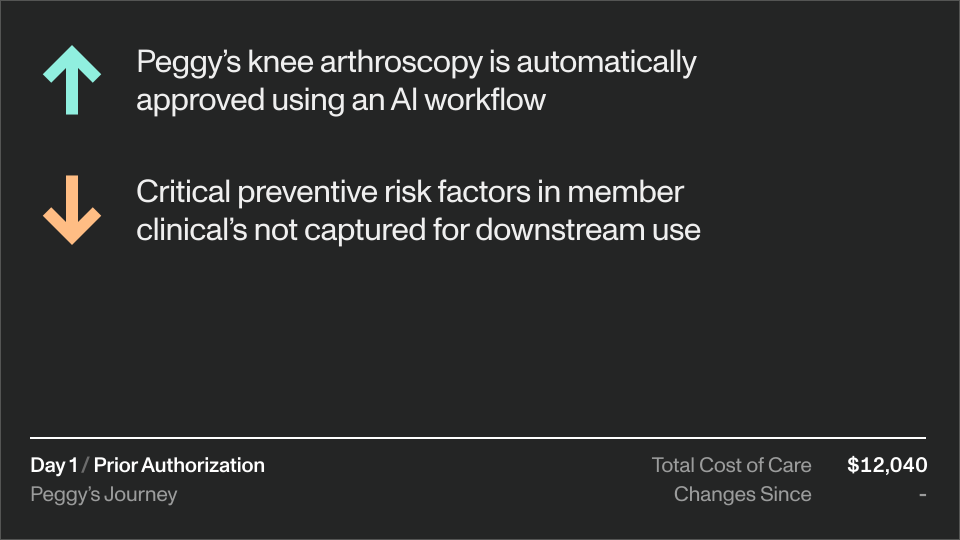
Each step that follows looks like progress, too. On day 21 Peggy calls about swelling in her knee. An AI voice assistant routes her to a care management nurse who has no access to anything utilization management saw three weeks earlier, and Peggy is admitted through the emergency department for three days. Her running cost passed $48,000. On day 45 an AI scheduling system notices she is missing physical therapy appointments and starts sending Ubers. It's the right intervention, but 45 days after the transport problem was first in her chart, and after poor rehab has already started to do damage.
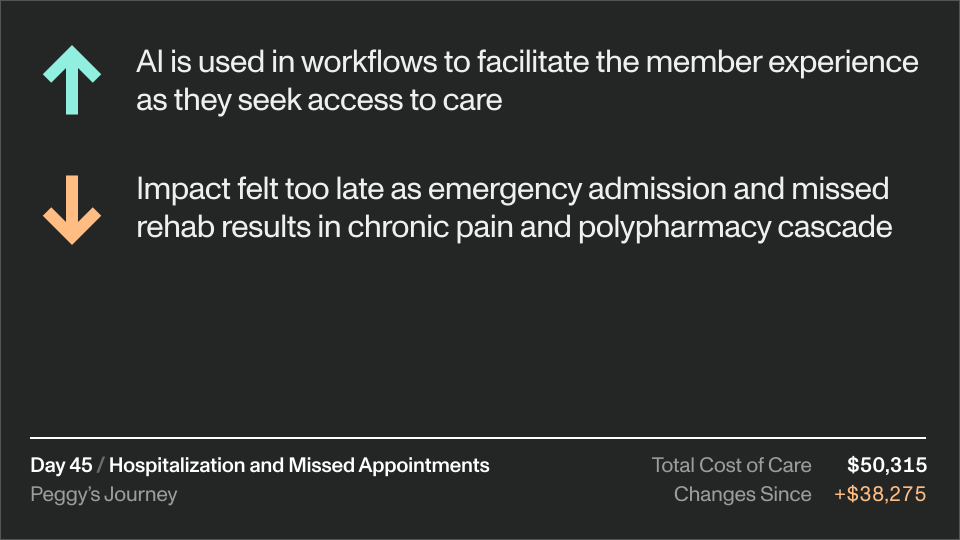
On day 120 an AI audit tool catches coding errors and billing for missed appointments, now chasing money that is already out the door. On day 270 the risk adjustment team runs an automated chart chase against a provider who already sent those charts, and the delay costs a RADV deadline.
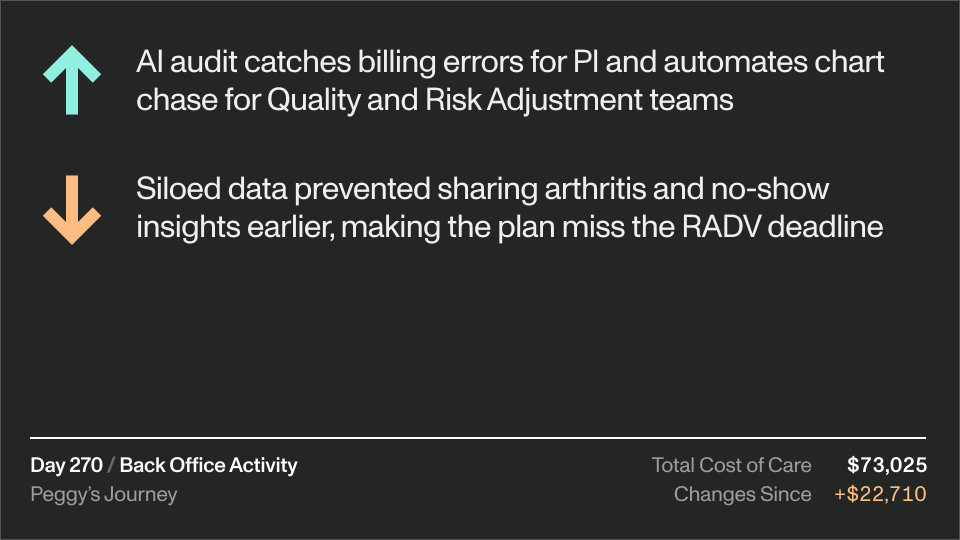
That's five different AI tools, all of which do the task they are set up to do, and optimize the metrics they were bought to improve: turnaround time, call handling, appointment adherence, dollars recovered, charts retrieved. Peggy is still worse off, and the plan has spent $73,025.7 This is what a faster horse looks like in production. Every intervention was a reaction, because each tool solely answered one department's question.
Let's imagine a different approach that uses the same technology. The difference is that the day 1 review reads the whole record, not just the fields a determination requires, and shares what it finds. The approval still happens automatically, now inside the EHR before the request is even submitted. The complication risk goes to care management and the transport barrier is flagged to the team that arranges rides. And Peggy herself is told which symptoms should worry her.
So on day 7, when the swelling starts, she recognizes it and calls, and it is handled the same day as an outpatient. The admission never happens, and rides are set up before rehab begins, so she finishes her physical therapy and the knee heals properly. The coding errors are caught before payment. The risk score is updated from data the plan already holds, so nobody chases a chart. By day 30 her costs stop at $13,1458, and across the remaining eight months there is nothing left to do but supervise her recovery and general health.
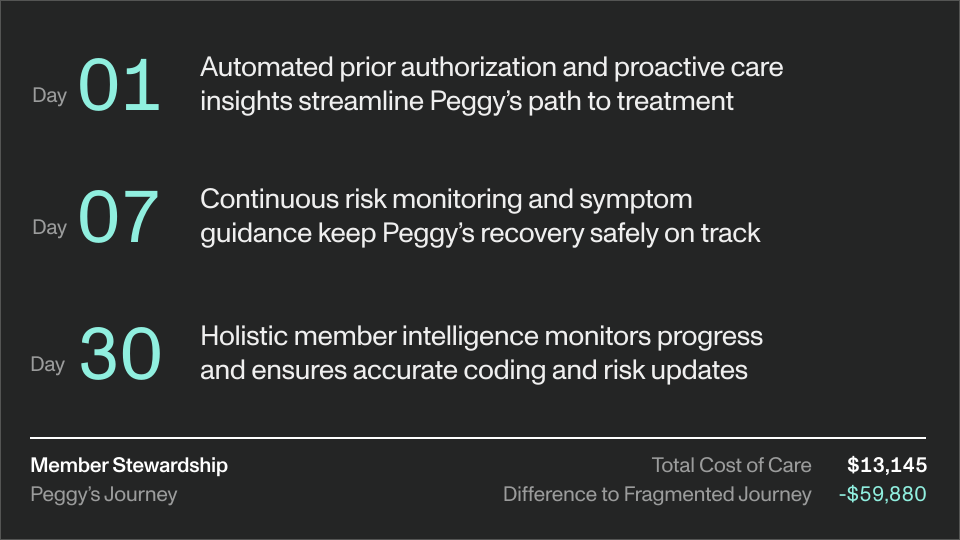
Everyone comes out ahead. Peggy avoids the hospital and gets the recovery the surgery was for. Her surgeon has a decision before submitting the request, with the reasoning attached, and is never asked twice for the same records. The plan spends 82 percent less on her care and captures the quality measures and risk adjustment factors it used to leave on the table.
I think a health plan that completely reinvents and rethinks itself with this new technology as a critical tool [is] going to outpace many others.
We call this approach to AI member stewardship — one system that connects all the different parts of a member's care, catches problems early, and makes sure the right person acts on it.
The uncomfortable part of the first journey is that it isn't a story about bad AI or bad intent. It is what happens when good AI is bought one function at a time by capable teams doing their jobs well. So the question for an executive team is not whether AI can do the work. It is whether the plan can deploy AI so that what one function learns reaches the others while it still matters for the member.
The City Housing Corporation never made its money back in Fair Lawn9 – the Depression broke the company before the town was finished10 – but it had seen what the car changed before almost anyone else.
Our industry has the same choice in front of us. We can use clinical AI to speed up the departments we have, and it will do that. Or we can start from what has actually changed: for the first time, a plan can afford to pay real attention, to every member, all the time.
But deciding to take down the silos is only the first step. What helped Ford to dominate the market was not the car; it was the assembly line — the system for producing cars at scale. Health plans now face the equivalent question: how to build, configure, deploy, orchestrate, and govern AI at enterprise scale.
Notes
- 1.
- 2.
- 3.
- 4.
- 5.
- 6.
- 7.
Peggy is an illustrative composite. The $73,025 and $13,145 figures are modeled estimates of care-related spending—not observed claims—directionally informed by AHRQ HCUP’s 2018 inpatient knee-arthroplasty cost data and CMS CJR’s 90-day elective joint-replacement payment data.
- 8.
See note 7.
- 9.
- 10.